

The holidays are just around the corner and you're wondering how to keep your houseplants happy while you're away? It's not easy, especially when you know that overwatering before you leave could be even more damaging than a lack of water. The real challenge is finding a way to maintain the right level of moisture over time. But don't panic — there are plenty of clever methods to keep your little corner of nature thriving while you're gone. We're going to walk you through the pros and cons of 7 tips that'll let you leave with total peace of mind. And by combining a few of them, you can even be away for several weeks!
1. Grouping your plants together
Keeping the ambient air and soil moisture up is key to the survival of houseplants. The first solution is to group your plants together in one spot. By doing so, you create a microclimate — plants produce moisture through evapotranspiration, and the drier the air, the more they transpire. Grouping your plants helps maintain ambient humidity, which reduces water loss through evapotranspiration. This means your plants use water more efficiently, buying you extra days of holiday! Ideally, group them somewhere like a bathtub, which also lets you set up a bottom-watering system. And bathrooms are naturally more humid spaces to begin with.
2. Plant sitting
Obvious… but not always an option if you don't have someone you trust to hand your keys to. That said, it's still the simplest solution. Combine this tip with the one above and you'll make life much easier for your plant sitter — they'll only need to add a little water to the bottom of the bathtub, or water all your plants in one go without having to do a full tour of the flat. The bonus: if you have a pet that also needs looking after, one person can handle both. The main downside is that if your plants have different watering needs, you'll need to leave a note, which can make the task a bit of a chore…
3. The oyas
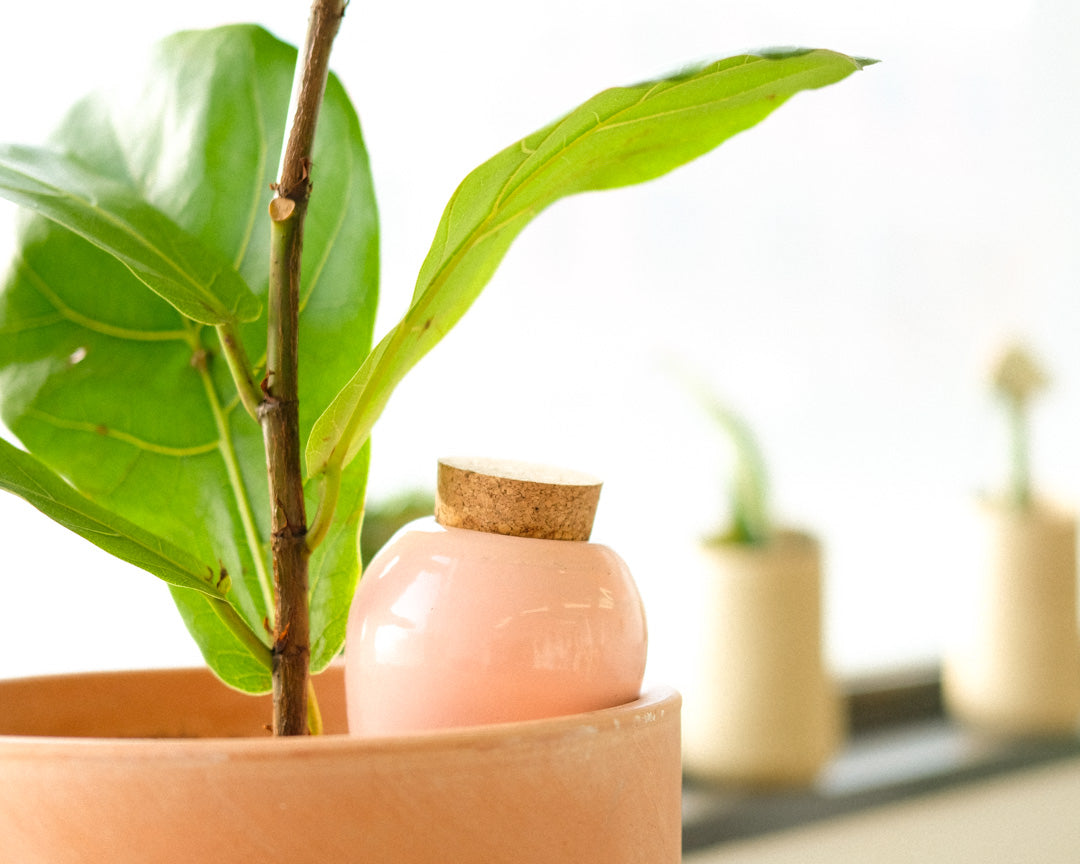
oyas (or ollas) are microporous clay water reservoirs that slowly release water to your plants. The plants regulate their own water intake by drawing water through capillary action directly from the clay. They also help prevent the evaporation of surface irrigation water. The savings can be as much as 70%! The significant advantage they offer is that you no longer need to worry about the individual needs of each plant. If you're going away for several weeks and have a plant sitter, they'll only need to check whether the oyas are empty before topping them up. The downside is that it can represent a significant cost if you have a lot of plants. DIY oya solutions using standard terracotta pots are possible, but less effective. oyas are fired at a very precise temperature to ensure the clay's porosity is optimal. If you go down the DIY route, it's worth testing them well in advance so you're not caught out.
4. Self-watering pots
Self-watering pots are an alternative to oyas, but the cost can be higher if you care about how they look. They are still very effective when matched to the right plant size. If your plant is too large, the roots may end up sitting in water and could start to rot.
5. Mulching your houseplants
Well, yes. Mulching is a well-known technique among gardeners — it involves applying a layer of organic or mineral material to the surface of the soil to protect it from sunlight or frost, and to keep it moist. Of course, we're not going to pile 20 cm of hay or 10 cm of horse manure on our plants (although…), but there are plenty of more aesthetic options that are just as effective. You could use, for example, clay pebbles, coconut fibre, or even pebbles collected from the beach (just make sure to wash them first).
6. The soaked cotton wicks
With this method, you connect your plants to a basin of water using cotton wicks. The main advantage is that it allows you to be away for long periods. The more water you put in the basin, the longer the system will be self-sufficient. To set it up, you'll need suitable wicking material — as absorbent as possible — which you can easily find at a garden centre or online.
Step 1: Cut the wicks to the right length. One end needs to be pushed at least 5 cm into the compost, and the other end should sit in the water.
Step 2: Leave the wicks to soak in water for a few minutes. Then start by pushing one end into the compost, making sure it is in good contact with the soil. To keep it in place, you can use wooden sticks. Place the other end in the reservoir.
Step 3: Fill the basin with water and water your plants. There needs to be a continuous connection between the compost and the basin, a bit like the principle of communicating vessels.
7. Creating a greenhouse effect with a cloth
This is the method that will allow you to be away for the longest time. After watering your plant, place your cover over it and strap it around the pot. Beforehand, place stakes in your pot to prevent the cover from coming into too much contact with the plant's leaves. By doing this, you'll create a greenhouse effect that condenses the evaporating water and causes it to fall back into the soil. This ultimately recreates a mini water cycle on the scale of your plant.


