

- Light ☀️
It prefers moderate to bright indirect light. Avoid placing it in direct sunlight, as this can burn its delicate leaves. - Watering 💧
The syngonium likes slightly moist soil, but it is crucial to avoid overwatering. Water when the top of the soil begins to dry out, using water at room temperature.
- Signs of an unhappy plant 🤒
Drooping: soil too dry
Brown and crispy leaves: needs water
- Easy to keep alive ❤️🩹
❤️🩹❤️🩹❤️🩹❤️🩹❤️🩹/5
The Syngonium Podophyllum, also known as Nephthytis (its former name), is a highly popular houseplant loved for its beauty and ease of care.
Native to the tropical forests of Central and South America, this climbing plant is perfect for those who tend to struggle keeping their plants alive.
Origin and natural habitat
The Syngonium Podophyllum is native to the humid forests of Central and South America. It naturally grows as a hemi-epiphytic plant, meaning it can grow partially on trees while spending part of its life in the ground.
This plant is most commonly found in humid and tropical environments.
Although it is native to these regions, it has managed to adapt to various climates and can sometimes become invasive in tropical and subtropical areas such as Florida or Indonesia.
In cooler climates, such as the north-east of the United States, it must be grown indoors to survive.
Morphological characteristics
The syngonium is particularly interesting due to its heterophylly, meaning its ability to change the shape of its leaves at different stages of growth.
Young syngonium plants have arrow-shaped leaves — you will most likely encounter them in this form in garden centres and plant shops.
As the plant matures, the leaves begin to divide into several parts, progressing from a simple arrow shape to a more complex leaf that can have up to 10–12 leaflets.
This transformation makes each syngonium unique and fascinating to observe!
There are many varieties of syngonium, each with its own distinct characteristics.
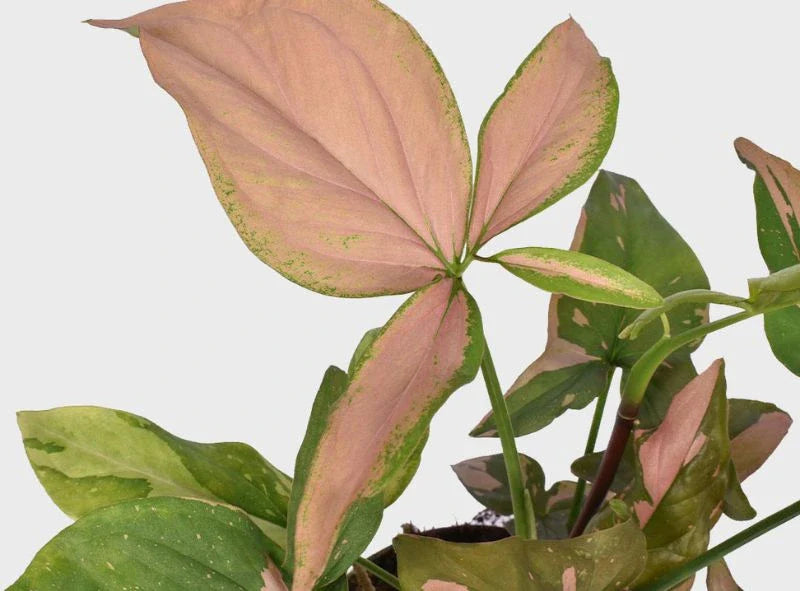
Among the most popular are the "Pink Illusion", known for its pinkish-tinted leaves — this variety remains relatively compact and bushy; the "White Butterfly", featuring pale green leaves with white veins and tending to be slightly more climbing in habit; and the "Neon Robusta", characterised by its bright pink leaves, adding a vibrant touch to any interior.
Growing and care tips
The syngonium prefers moderate to bright indirect light. Avoid placing it in direct sunlight, as this can burn its delicate leaves.
An east- or west-facing window is ideal.
If you don't have enough natural light, a grow lamp can be a good alternative.
The syngonium likes slightly moist soil, but it is crucial to avoid overwatering. Water when the top of the soil begins to dry out, using water at room temperature.
During the active growing months (spring and summer), maintain consistent moisture.
In winter, reduce watering slightly.
This plant thrives in temperatures between 15 and 25°C.
It appreciates high relative humidity. To increase humidity, mist its leaves regularly or use a humidifier. You can also place the plant on a pebble tray filled with water to create a humid microclimate. Use a well-draining potting mix rich in organic matter. A mix of houseplant compost with a little perlite or sand is ideal.
And a little tip: repot your syngonium every two years to give its roots enough space and to refresh the growing medium.
How to make your syngonium climb
The syngonium is naturally a climbing plant. To encourage this vertical growth, use stakes or trellises.
A moss or sphagnum pole can offer ideal support for its aerial roots, allowing the plant to grip and climb more easily.
Make sure the stake is sturdy enough to support the plant as it grows. Regular pruning of your syngonium is essential to maintain a compact shape and encourage healthy growth.
Prune any invasive or unruly stems just above a node to encourage branching. The cuttings obtained can be easily propagated. To propagate your syngonium, cut a stem section with at least one leaf and one node.
Place the cuttings in a glass of water until roots form, then transplant them into compost, or plant the cuttings directly into a moist potting mix and place them in a bright, warm spot.
To develop your syngonium cuttings, you can add willow water to your watering water.
This patural preparation made from willow bark is designed to stimulate root development in your cuttings, seedlings and plants after repotting.
Precautions and common problems
The syngonium contains calcium oxalate crystals, which can be toxic to pets and children if ingested.
It is therefore essential to place the plant out of reach of children and pets.
Interior decoration with the syngonium
The Syngonium is ideal for hanging baskets thanks to its long, trailing stems. Place the basket in a bright spot but away from direct sunlight.
The trailing stems will add an interesting visual dimension to your space, while bringing a soothing touch of greenery.
The Syngonium is also perfect for offices. It requires little maintenance and can thrive in indirect light. Place it on a desk or a shelf to brighten up the workspace. The plant helps improve air quality by filtering toxins, making it a healthy and aesthetic addition to any work environment.


