

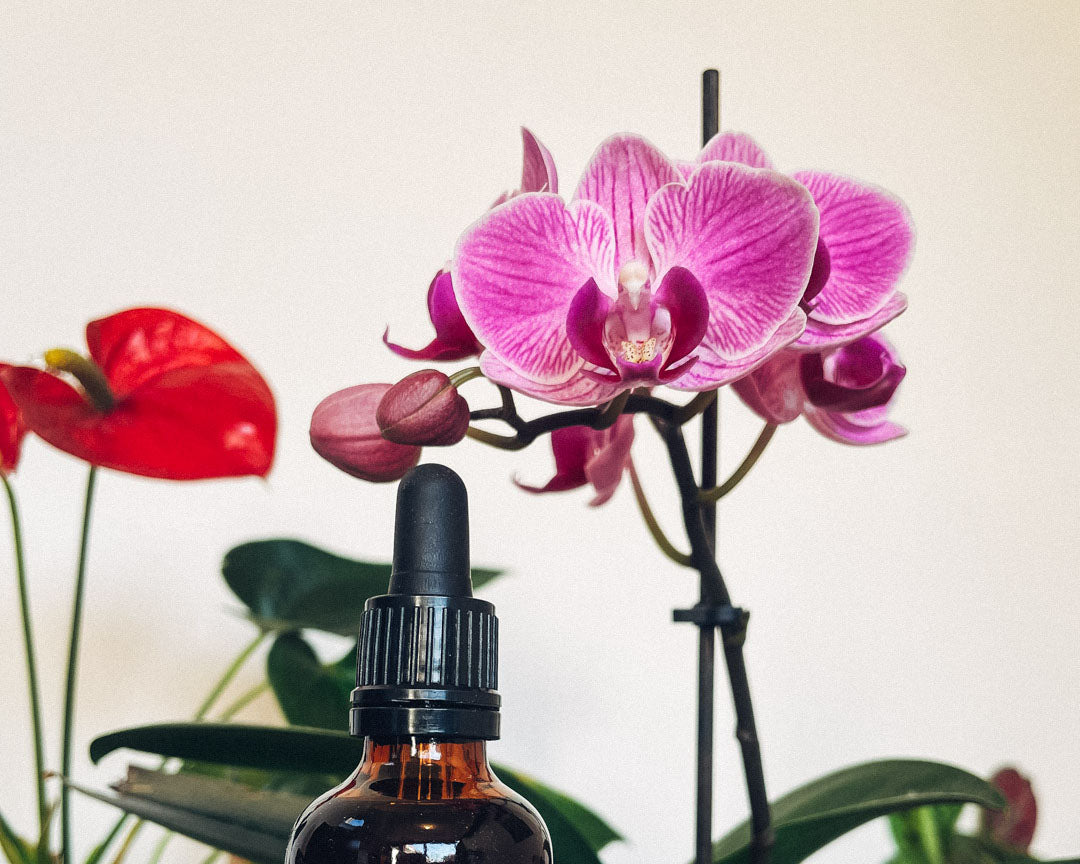
For many years, orchids have become an essential plant in garden centres. With their flowers of rare elegance, phalaenopsis can be a gift that is both refined and sophisticated, easy to pair with an interior décor. It's no wonder they are the third best-selling plant in France, with 5 million pots per year!
However, its biggest problem is that very often, its flower ends up fading within a few weeks. What remains are just two leaves and a straggly stem, leaving us puzzled by the eternal question: "When and above all how will my orchid bloom again?"
As is often the case, you'll find the simplest answer by adopting a biomimicry approach… Take inspiration from what happens in nature and try to replicate it. Although there are 160 species of wild orchids in France, the varieties found in shops are closer to species living in equatorial zones. They will feel at home in warm, humid environments and will appreciate slight temperature variations between day and night.
So, to hope to see your orchid bloom, master the flowering period and act on 3 fairly simple parameters: light, temperature, and a suitable fertiliser correctly applied.
When do orchids bloom?
This can vary from one species to another. But generally, they bloom twice a year, in spring and in autumn. Be careful not to confuse the flowering period with the period during which the plant is in bloom. Orchids that flower in autumn can keep their blooms for many weeks during winter. The most experienced growers can even keep their orchids in flower for almost the entire year.
Generally speaking, you need to understand that orchids have a cycle: growth/flowering/dormancy, which they repeat indefinitely, and which you'll need to get to grips with. If you were given a plant in bloom, it has since faded, and it is now just ticking over, it's probably because the conditions it's in are favouring stagnation in dormancy. This is the moment when you can act.
How much light does my orchid need?
Orchids need a lot of light. A south-facing position is essential to stimulate flowering. But be careful of direct sunlight, which can be harmful to them. During the summer months, place them behind a curtain, for example, to diffuse the light.
The very often overlooked feature of orchids is that they are epiphytic plants. That is, they naturally grow attached to trees or rocks. They don't need to be planted in compost. Their roots are capable of absorbing water and minerals from the surrounding air. This is why they are often found in transparent plastic pots. If you use a decorative outer pot, make sure you can fit 2 fingers between it and the inner pot.
This will allow the roots to develop properly. And if roots are protruding at the surface, let them spread around the pot. A good way to tell if your orchid is lacking light is to look at the leaves. If they are unusually large, or if they are turning yellow, it's a sign that a change of location should be considered.
What room temperature is best for my orchid?
Orchid enthusiasts often grow them in a greenhouse, to get as close as possible to their natural conditions. The ideal is a temperature of 20–30 degrees during the day, and 15–22 degrees at night. But don't panic, they can thrive in more standard conditions, as long as you keep a few things in mind.
Unlike their development in a natural environment, orchids have cycles influenced by our climate and indoor living. During the dormancy period, the plant renews and stores in its roots the nutrients that will be necessary for its flowering. To stimulate it, a temperature of around 15–20 degrees will be ideal.
What fertiliser does my orchid need?
Use a natural fertiliser for orchids. Its NPK ratio will be fairly concentrated in phosphorus to stimulate the health and development of its roots, and in potassium to meet the needs of flowering. You'll thus have robust roots capable of building up the reserves needed to boost flowering.
Opt for organic bio fertilisers, to be diluted in water to irrigate the substrate and roots. It is also possible to use foliar fertilisers (to be sprayed on the leaves). Orchids hate hard water. This is why some fertilisers are deliberately acidifying, in order to maintain an acid-base balance. The ideal is to use rainwater, which is closer to the runoff water they draw on in their natural conditions.
You're now all set to experience the unique pleasure of seeing your orchid bloom again! It might not work on the first try. Enthusiasts will tell you that you need to kill 100 orchids before you understand all their subtleties. But here is one of their best-kept secrets: your orchids will thrive wonderfully once you've understood how to not fuss over them too much…


