

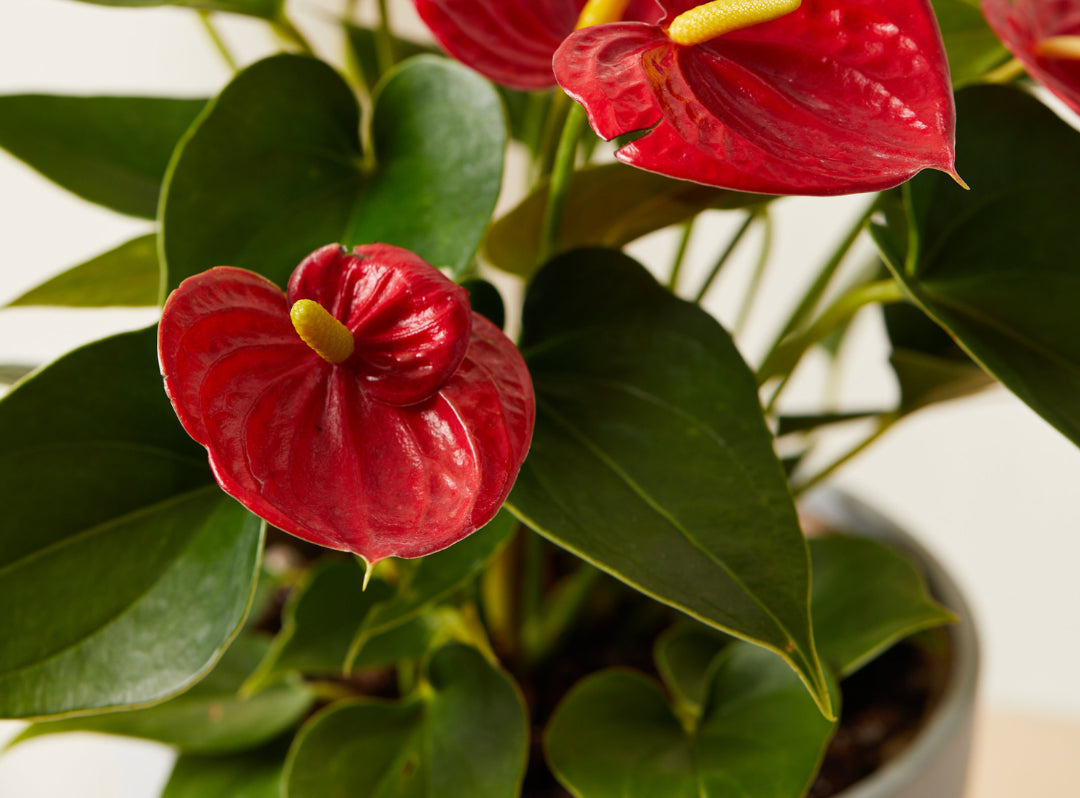
- ☀️ Light
Thrives in bright indirect light. Avoid direct sun.
- 💧 Watering
Water every 1 to 2 weeks, allowing the soil to dry out between waterings. Expect to water more often in brighter light and less often in lower light.
- 🤒 Signs of an unhappy plant
Yellowing leaves: too much direct sunlight
New flowers are green rather than red or pink: too much sun
Flowers turn pale green: underwatering or wrong temperature
- ❤️🩹 Ease of keeping them alive
❤️🩹❤️🩹❤️🩹❤️🩹/5
Everything you need to know about the Anthurium
This trendy plant is known and loved for its exotic beauty, its heart-shaped leaves and its vibrantly coloured flowers. The Anthurium is an ideal choice for those who love pops of colour and especially very cute plants.
History and origin of the Anthurium
The Anthurium belongs to a genus comprising around 950 species found across Central and South America. It is estimated that there could be up to 2,000 species, most of which have yet to be discovered 🤯
Among the most commonly cultivated species are Anthurium andreanum and Anthurium scherzerianum, renowned for their beautiful inflorescences and ease of cultivation. These plants are appreciated not only for their unique appearance but also for their resilience and ability to adapt to various environments.
Growing conditions
Anthuriums thrive in bright, indirect light. In their natural habitat, they grow under the canopy of tropical forests, benefiting from filtered light. Place them indoors near a window and position them so the light is diffuse and not too direct.
These plants love warmth and humidity.
Maintain a temperature between 21°C and 32°C and avoid cold draughts. Also make sure not to place your Anthurium near sources of cold such as open windows in winter or air conditioning in summer, as this could stress the plant.
Watering and fertilising
The Anthurium should be watered regularly, but the soil must drain well to avoid standing water. Use a light, airy compost mix, ideally made up of perlite and bark. This will allow water to circulate freely and prevent the roots from rotting.
During the growing season (March to October), you can use our nourishing serum for green plants. This formula will encourage flower production and keep the plant healthy.
It couldn't be simpler to use!
Add 3 drops to 250 ml of water when watering.
You can use it every other watering during the growing period.
Care and pruning
Wipe the leaves with a damp cloth to remove dust and improve photosynthesis. This allows the plant to breathe and absorb light more effectively. Trim faded leaves and flowers to encourage the growth of new inflorescences.
You can also divide the plant to propagate it. By cutting away damaged or dead parts, you will stimulate the plant to produce new shoots and remain vigorous.
Propagation
Gently remove the plant from its pot, separate the clumps by untangling the roots, and repot each section into a new pot with the appropriate soil mix.
This method is simple and effective for multiplying your plants without needing complex growing techniques. Make sure each new plant has enough space to develop and continue to water and fertilise them regularly.
Common problems and solutions
Yellowing leaves can be caused by too much or too little water. Make sure the soil is moist but well-drained. Brown spots may indicate direct sun exposure. Move the plant to a spot with indirect light.
If your plant isn't flowering, check the light and try stimulating it with a natural fertiliser.


